
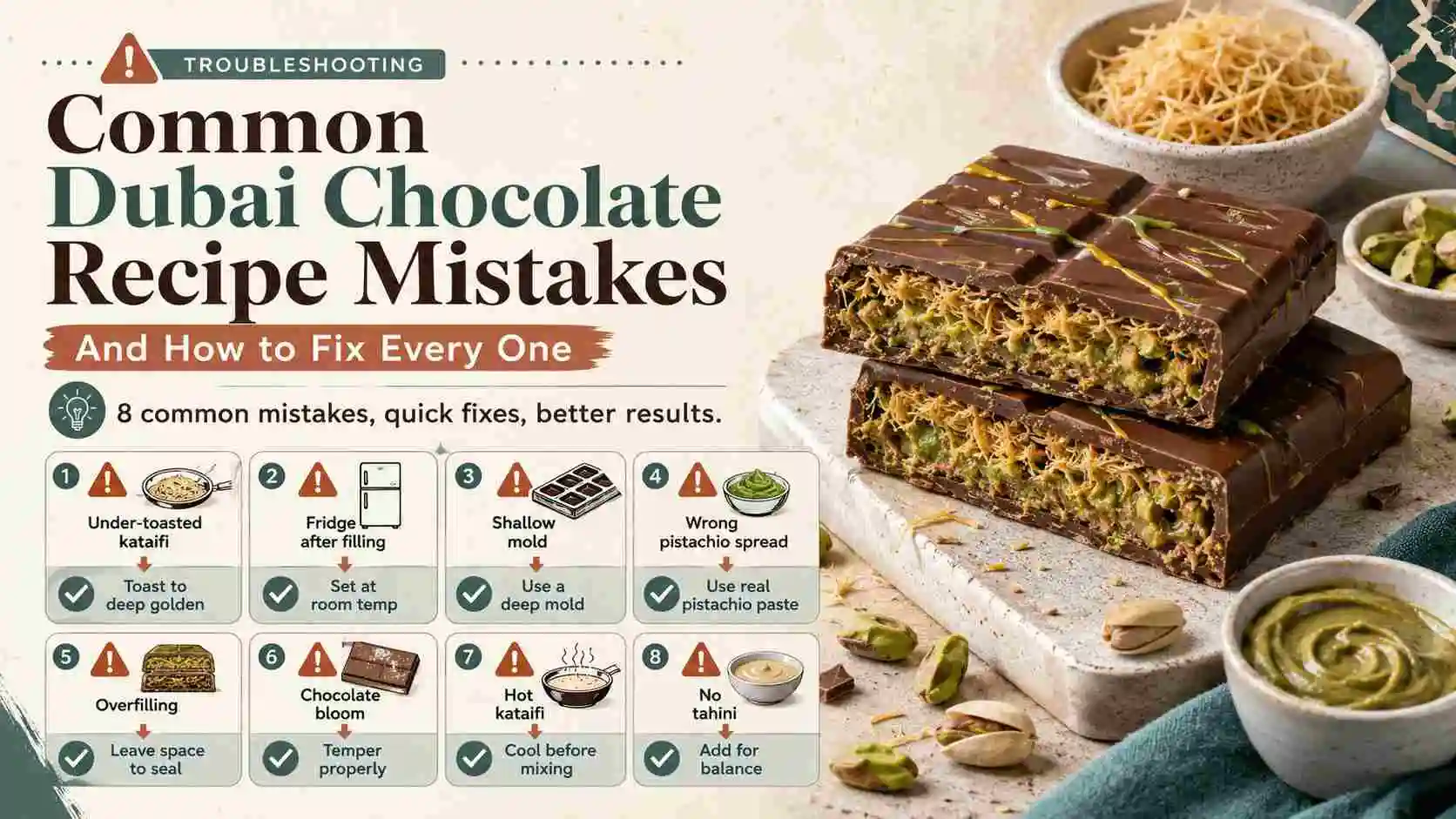
Common Dubai Chocolate Recipe Mistakes — And How to Fix Every One
| QUICK ANSWER The most common Dubai chocolate recipe mistakes are: under-toasting kataifi (it softens within hours), refrigerating after filling (ruins the filling texture), using a shallow mold (bars crack), overfilling the mold (seals fail), and using pistachio-flavored spread instead of real pistachio paste. Every one of these is preventable once you know what to watch for. |
If you’ve made Dubai chocolate at home and something went wrong — the kataifi turned soft, the bar cracked, the filling was runny, or the chocolate looked dull with white streaks — you’re not alone and you didn’t fail. You just ran into the same set of problems that trips up almost every first-time home baker who tries this recipe.
Here’s the thing: Dubai chocolate isn’t technically difficult. The ingredient list is short. The steps aren’t complicated. But there are specific points in the process where small missteps create big problems — and most recipes skip right over them.
This guide covers every common Dubai chocolate recipe mistake in detail. Not just what goes wrong, but exactly why it happens and how to make sure it doesn’t happen to you. If you want the full step-by-step recipe before reading this, start with our Dubai chocolate bar recipe guide and come back here when something isn’t going right.
For full details, read how to store Dubai chocolate properly.
Mistake #1: Under-Toasting the Kataifi
| Mistake #1: Under-Toasting the Kataifi | |
| ❌ What goes wrong | ✅ How to fix it |
| The kataifi looks golden enough in the pan but softens within hours of being sealed inside the bar. The crunch disappears and the filling becomes dense and chewy. | Toast longer than feels comfortable. Kataifi needs to reach a deep, almost amber golden color — not pale gold. Stir constantly on medium heat for 8–10 minutes. It should smell nutty and slightly caramelized. When it looks like it might be too dark, it’s usually just right. |
This is the single most common mistake — and the most impactful one. The crunch is the whole point of Dubai chocolate. Under-toasted kataifi holds moisture from the pistachio cream and softens from the inside out.
Let it cool completely on paper towels after toasting. Any residual steam will also soften it if you rush the mixing step. If you want to go deeper on this, our guide on how to keep kataifi crispy covers every factor that affects crunch — including storage after the bar is assembled.
Mistake #2: Refrigerating the Bar After Adding the Filling
| Mistake #2: Refrigerating After Filling | |
| ❌ What goes wrong | ✅ How to fix it |
| The pistachio filling turns firm, dense, and loses its gooey, creamy quality. The bar tastes like cold nut paste instead of a flowing, rich filling. The kataifi also softens from condensation. | Only refrigerate the initial chocolate shell layer to set it. Once you add the pistachio-kataifi filling, seal the bar, and let it set at cool room temperature — ideally between 65–70°F. The chocolate will still set properly. The filling stays creamy and the kataifi stays dry. |
A lot of home bakers put the entire bar in the fridge because it feels like the logical way to set chocolate. It works for the shell — but the moment pistachio cream is involved, refrigeration is the enemy.
Cold temperature firms up the oils in the pistachio paste and draws moisture into the kataifi. Both effects destroy what makes Dubai chocolate worth making. Room temperature setting takes about 25–30 minutes and produces a far better result. Our storage guide covers the full rules for keeping bars properly once they’ve set.
Mistake #3: Using a Shallow Mold
| Mistake #3: Using the Wrong Mold | |
| ❌ What goes wrong | ✅ How to fix it |
| The shell is too thin relative to the filling. The bar cracks when removed from the mold or when bitten. There isn’t enough room for a proper filling layer and the ratio is off. | Use a silicone mold that is at least 1 inch (2.5cm) deep. This depth lets you build a shell with enough thickness (3–4mm) while still having room for a generous filling and a sealing layer. Silicone releases far more cleanly than hard plastic molds. |
The mold question matters more than most recipes admit. Shallow molds force you to choose between a thick shell and a full filling — you can’t have both. The bars that look like the ones in TikTok videos come from deep molds with proper cavity space.
If you don’t have a mold at all, there’s a simple workaround — our easy Dubai chocolate recipe without a mold guide shows you how to get the same result using a lined baking dish. It’s a different shape but the flavor is identical.
Mistake #4: Using Pistachio-Flavored Spread Instead of Real Pistachio Paste
| Mistake #4: Wrong Pistachio Product | |
| ❌ What goes wrong | ✅ How to fix it |
| The filling tastes sweet and artificial rather than nutty and complex. The green color is bright and fake-looking rather than natural. The filling is too runny and doesn’t hold structure inside the bar. | Use 100% pistachio paste — ground roasted pistachios with nothing added. Check the label: the only ingredient should be pistachios. Avoid any product that lists sugar, palm oil, or ‘pistachio flavor’ as primary ingredients. |
This one is easy to get wrong because the products look similar on the shelf. Pistachio spread, pistachio butter, and pistachio paste are not the same thing. The spread is usually sugar-forward and made for toast, not chocolate bars.
Real pistachio paste is thick, deeply nutty, and has a natural muted green color. It’s available at Middle Eastern grocery stores and on Amazon. If you’re unsure what to buy, our Dubai chocolate ingredients guide has a full breakdown of every ingredient including where to source them in the US.
Mistake #5: Overfilling the Mold
| Mistake #5: Too Much Filling | |
| ❌ What goes wrong | ✅ How to fix it |
| The filling spills over when you try to seal the bar. The chocolate sealing layer doesn’t bond properly and the bar splits open when unmolded or bitten. | Fill to about 3–4mm from the top of the mold cavity. You need that space for the sealing layer of chocolate to sit flat and bond to the shell walls. Press the filling down firmly with the back of a spoon before sealing — this also removes air pockets. |
More filling feels like it should be better — but overfilling is one of the most reliable ways to end up with a bar that breaks apart completely when you try to eat it. The seal is structural. If it doesn’t have room to form properly, nothing holds together.
Take your time on this step. Pack the filling in, level it, and leave the right amount of headspace. It’s the difference between a bar that snaps cleanly and one that crumbles.
Mistake #6: Chocolate Blooming (White Streaks on the Surface)
| Mistake #6: Chocolate Bloom | |
| ❌ What goes wrong | ✅ How to fix it |
| White or grey streaks and patches appear on the surface of the bar. It looks unappetizing even though it still tastes fine. It can also happen after the bar is stored. | Temper the chocolate properly — heat to the correct temperature, cool down, then reheat to working temperature. A kitchen thermometer makes this reliable. For milk chocolate: melt to 115°F, cool to 82°F, reheat to 88–90°F. Also avoid moving bars from cold to warm environments after setting. |
Bloom happens when cocoa butter crystals destabilize — usually from improper tempering, temperature shock, or moisture. It’s purely cosmetic and the bar still tastes fine, but if you care about how it looks, tempering is worth learning.
Let’s be real — your first bar probably won’t have a perfect glossy finish. That’s okay. The flavor will still be excellent. Focus on the filling first, temper the chocolate once you’re comfortable with the rest of the process.
Mistake #7: Hot Kataifi Mixed with Pistachio Cream
| Mistake #7: Mixing Kataifi While Still Hot | |
| ❌ What goes wrong | ✅ How to fix it |
| The heat from the kataifi melts the pistachio cream partially, creating a greasy, loose filling that won’t hold structure. The kataifi also loses some of its crunch from the steam. | Let the toasted kataifi cool completely — at least 10 minutes spread on paper towels — before mixing with the pistachio cream and tahini. The filling should be assembled at room temperature, not warm. |
This is a timing mistake rather than a technique mistake. The fix is simple: just wait. Ten minutes of patience here makes the difference between a filling that holds together and one that’s a greasy, loose mess.
Mistake #8: Skipping the Tahini
| Mistake #8: Leaving Out the Tahini | |
| ❌ What goes wrong | ✅ How to fix it |
| The filling tastes flat, overly sweet, and one-dimensional. It’s missing the savory depth that makes every bite interesting rather than just sweet. | Add 2 tablespoons of pure tahini (sesame paste) to the pistachio cream before mixing. It’s a small amount but it changes the entire flavor profile. The original Fix Dessert Chocolatier bar includes it. Most premium US brands include it. There’s a reason. |
Tahini is the ingredient people skip when they can’t find it or don’t want to buy a whole jar for two tablespoons. But it’s worth it. The nuttiness and slight bitterness of sesame is what stops the bar from tasting like a pistachio candy bar.
You’ll find tahini at every major US grocery store now — Whole Foods, Trader Joe’s, Walmart, Target. Brands like Soom and Mighty Sesame are reliable. Once you have it, it lasts months in the fridge and you’ll find yourself reaching for it far more than expected.
All 8 Mistakes — Quick Reference
| Mistake | What Happens | Quick Fix |
| Under-toasted kataifi | Softens within hours | Toast to deep golden — 8–10 mins |
| Fridge after filling | Filling goes firm, kataifi softens | Set at room temp only |
| Shallow mold | Bar cracks, poor ratio | Use 1-inch deep silicone mold |
| Wrong pistachio product | Sweet, artificial, runny | 100% pistachio paste only |
| Overfilling | Seal fails, bar splits | Leave 3–4mm space at top |
| No tempering | Chocolate bloom | Use thermometer, temper properly |
| Hot kataifi + cream | Greasy, loose filling | Cool kataifi 10 mins first |
| Skipping tahini | Flat, one-note sweetness | Add 2 tbsp tahini always |
The Bottom Line
Every one of these mistakes is fixable — and most of them come down to patience rather than technique. Toast the kataifi long enough. Let things cool properly. Use the right pistachio paste. Don’t refrigerate after filling. Give the sealing layer room to bond.
Dubai chocolate has a short ingredient list and a straightforward process. The failure points are specific and predictable. Now that you know where they are, your next bar will be significantly better than your first.
For the full step-by-step recipe with timings, see our Dubai chocolate bar recipe. And if you’re still having trouble with the kataifi specifically, the dedicated guide on how to keep kataifi crispy covers every variable that affects crunch — from toasting temperature to assembly order to storage.
People Also Ask
Why is my homemade Dubai chocolate kataifi soft?
Two reasons: the kataifi wasn’t toasted long enough (it needs to reach deep golden, not pale gold), or the filling was assembled while the kataifi was still warm. Toast for 8–10 minutes on medium heat until deeply golden, let cool completely on paper towels, then mix.
Why did my Dubai chocolate filling come out runny?
Usually a pistachio product issue. If you used pistachio spread or a product with added oil, the filling will be too loose. Switch to 100% pistachio paste — no added oils, no sugar as the first ingredient. The paste should be thick enough to hold its shape at room temperature.
Why does my Dubai chocolate have white streaks?
This is chocolate bloom — caused by improper tempering or temperature changes after setting. It’s cosmetic and the bar still tastes fine. To prevent it, temper your chocolate properly and don’t move bars from cold to warm environments after they’ve set.
Can you make Dubai chocolate without a silicone mold?
Yes. Line a small loaf pan or baking dish with parchment paper, pour in a chocolate layer, set it, add filling, seal with more chocolate, and refrigerate to set the final layer. Cut into bars when fully set. See our easy Dubai chocolate recipe without a mold for full instructions.